Monday, October 20, 2008

Pradeep SV: Redefining My Blog Objective

Today while coming to office, I was thinking about this blog (pradeepsv.blogspot.com) I have left completely idle from last few months, and also i was thinking about on what intent i had started this blog, what was the objective of it, My profile or the field I am working right now since last 3+ years i,e Web Analytics are has changed the way i think... Seriously believe me .. I always think how organized i can work or execute whatever i do (doesn't i never used to think before, it has thoughts and thinking has increased and striving to accuracy), it can be writing blog, cooking at home, cleaning my room, planning for a weekend, i want to be perfect and extract best of it.

I always ask myself what is the objective of what i am doing and how do you measure success, sometime i give the name "passion" if i don't find any objective behind it ;-) say for example buying an iPhone (though i use phone just for talking why do i need high end phone isn't it passion - i never bought yet thats a different story ;-) ) there are may of this sort which we normally tag it with passion.

Ooppss .. i easily go out of focus .. yeah i was talking about the reach or the context of this blog, until today i used to put all what i read anywhere it may be (copy paste) and what I observe (my own) and what i see interesting (usually copy paste) didn't had anything in my mind earlier and today i am thinking i should have something as objective and serve some purpose today or later at least to one person (me ;-) ..).

I am thinking it doesn't any specific audience in my mind except me, my friends, my dear and near one's, all those what want to know what my minds thinking and last but not the least FOR THOSE ONE WHO HATE ME (trust me i never hated you and i still love you and love you all)

So, thats the short update and decided to keep everything aside and just talk or write "WHATEVER MY MIND SPEAKS" i really want to document what I think and every moment and see how the change has occurred? How I could change to make myself better?, what I could have done to make it move on my way or smoother.

Summary/Conclusion
  • I am redefining my blogs objective
  • I will be writing whatever my mind speaks and thinks (May be not all but what i can share)
  • I will write all my observations, my experience my thoughts.
  • I promise it will not hurts anyone's feeling while I write anything on anybody

Please Note: Whatever I write is not anyone’s perspective or solely my personal views, and it not written to hurt anyone’s feelings or anyone’s mind sets, Just in case un-knowingly if I had written anything odd or which obstructs anyone's perspective please do send me a mail to pradeep_soft@hotmail.com and I will remove the post/words if I feel its genuine.

Some of the Blot Stats till today before I leave

I will update this as an when I feel it has to be changed to make it better.

Friday, July 25, 2008

Bangalore Bomb Blast ......

Hey I just got the news there is bomb blash in two places in bangalore - India, Mysore road and Madiwala ..2 dead .. i will udpate it further as i get the news

Friday, June 27, 2008

Microsoft's founder and head Bill Gates steps down

The founder and head of Microsoft, the world's largest software company Bill Gates steps down on Friday.

One of the richest men in the world, Gates will now work full time for his charitable organization The Bill & Melinda Gates Foundation.

The 52-year-old will continue to be chairman though, but will only retain a nominal role in the software empire.

He is still is the biggest shareholder of the company and his 8.7 per cent stake in Microsoft is worth about 23 billion dollars.

Gates authored the personal computer revolution three decades ago when he founded Microsoft along with his friend Paul Allen.

It is almost unthinkable that any one human could pick up where BillGates leaves off when he ends his full-time tenure Friday as Microsoft's leader.

But as Gates bones up on epidemiology at his charitable foundation, the software company he built with a mix of visionary manifestos and extreme hands-on management must still wake up Monday to face hard problems even he could not solve. Among them: beating Google Inc. on the Web while fending off its attacks on desktop computing.

When Microsoft Corp. announced in 2006 that Gates planned to go part-time as board chairman, so he could spend more time on his global health charity, it named two senior executives to guide the company's overall technical direction.

Gates' recent remarks, however, indicate Microsoft is looking to a much larger group of employees for big-picture guidance and long-term planning. But it's not yet clear whether the company can replicate his thinking with more traditional corporate processes or whether it should even be trying.

From Microsoft's start in 1975, Gates has been the company's genius programmer, its technology guru, its primary decision maker and its ruthless and competitive leader.

He would famously disappear into the solitude of a country cabin to digest employee-written papers and ponder the future of the industry, then emerge with manifestos, including the 1995 ''Internet Tidal Wave'' memo, that could shift the focus of the entire company.

He is credited by analysts and academics for the emergence of software as a moneymaking industry; previously it had been a pastime for hobbyists or a subset of the hardware sector. He is revered by many engineers, despite his propensity to fling expletives at underlings whose ideas he scorned. And he has built Microsoft into a hugely successful monopoly that has only grown stronger despite major losses in antitrust trials in the US and Europe. More on IBN News ;-)

Thursday, June 26, 2008

IPHONE IS IN INDIA NOW YEPPEEEEEE !!!!!!!


At last long awaited iPhone is in India now where we can buy legally ;-) ... LOSER !! Grey iPhone users ;-) hehehe

Cheers !!! I have already booked it .. and you too GO GET IT (Use Mastercard lol )

Saturday, May 31, 2008

छोडो न मुझे यूं बेकरार सा

I am so fascinated about this song that i should write this in Hindi......


छोडो न मुझे यूं बेकरार सा
कर भी दो इजहार तुम अपने प्यार का
तुम्हारे दिल की है ये मंजिल मेरा दीवाना दिल
बोलो तुम बोलो
हो ओ हो ओ
कर दोगे इनकार टू जी न पायेंगे
जो कर दोगे इकरार टू मर ही जायेंगे
तुम्हारे दिल की है ये मंजिल मेरा दीवाना दिल
बोलो तुम बोलो
हो ओ हो ओ येः

इतने पराये जो हो तुम पहले कभी भी न थे
मेरे जहाँ में घमों की हो
तुम टू वजह ही नहीं थे
दिल से मेरे तुम ख़ुद को निकालो
या फिर मुझे ही अपना बना लो
बोलो तुम बोलो
हो ओ हो ओ

खोयी खोयी ज़िंदगी की
राहों में अब आ भी जाओ
जो तुम नहीं आना चाहो मुझको ही पास बुलाओ
कब तक जियेंगे ऐसे बताओ
मुझको नहीं तुम आजमाओ
बोलो तुम बोलो
ओ ओ हो ओ
छोडो न मुझे यूं बेकरार सा
छोडो न मुझे हूँ
कर भी दो इजहार तुम अपने प्यार का
तुम्हारे दिल की है ये मंजिल मेरा दीवाना दिल
बोलो तुम बोलो
हो ओ हो ओ हो ओ हो ओ

Arun Sarin's Vodafone legacy STEPS DOWN !!!!

News that Vodafone's worldwide boss Arun Sarin will step down in July came as a bit of a surprise, but from a personal point of view his timing is perfect.

He leaves as Vodafone posts a full-year profit of a whopping 6.6 billion pounds and Vodafone benefits reaps the rewards of its move into emerging markets like India, which has propped up the company's growth rate.

It was a different story a couple of years ago, when Sarin was weathering a shareholder tussle to get rid of him. Some of Vodafone's influential shareholders were frustrated that Sarin, who took the role as CEO in July 2003, hadn't outlined a plan to deal with flagging growth in Vodafone's stronghold - Europe.

There were some nasty headlines at the time and the crisis threatened to split the company's upper management. In a shareholder vote at the time 10 per cent of ballots were cast against Sarin. But the board backed him, and a good move that has turned out to be.

When I saw Sarin speak at the 3GSM conference in Barcelona last February he stole the show with his articulate vision for entering emerging markets - in Vodafone's case, India and Turkey in particular. India has been the real success story for Vodafone and now the company has its eye on expanding its presence in China - the other booming mobile market.

That's his real legacy - taking the plunge into new markets, spending big to do so and ensuring Vodafone executes well in those markets.

He's also been responsible for steering Vodafone away from a mobile-only strategy to one where the company has admitted it needs to be in the fixed-line broadband game as well. You don't have to go further than New Zealand to see evidence of that.

Vodafone's purchase of ihug in 2006 was one of the early signs that the worldwide group planned on becoming a full service provider offering triple-play offerings under the Vodafone banner. Other investments in broadband operators around the world has re-inforced that strategy.

Sarin only visited New Zealand twice on short trips. Herald Business editor Liam Dann interviewed him on his last trip here in March when Sarin was given an official welcome at the airport and met with the prime minister.

"New Zealand is leading the parade within the Vodafone family in terms of taking us to the world we are going to." Sarin told Dann.

Where Sarin's track record hasn't been so good is in innovating on services and picking winners in Vodafone's core mobile market. He panned the iPhone before this year signing a deal to bring the phone to ten countries through Vodafone.

Rival mobile operators have gained ground on Vodafone in the most competitive markets through the introduction of attractive all-you-can-eat data plans, strategic mobile phone handset partnerships and by doing away with the walled-garden approach to mobile content epitomised by the Vodafone Live portal.

Still, for a 53 year old CEO who has weathered some rough times at Vodafone, now is a good time to go out. The British press has come to the conclusion that Sarin is quitting while he's ahead. It's hard to come to any other conclusion than that.

Tuesday, February 12, 2008

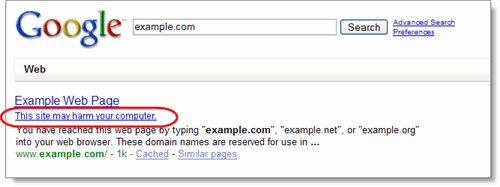
Did you know? - Why do some of my search results say 'This site may harm your computer?'

Google want its users to feel safe when they search the web, and continuously working to identify dangerous sites and increase protection for our users. This warning message appears with search results we've identified as sites that may install malicious software on users computer:

Malware warning

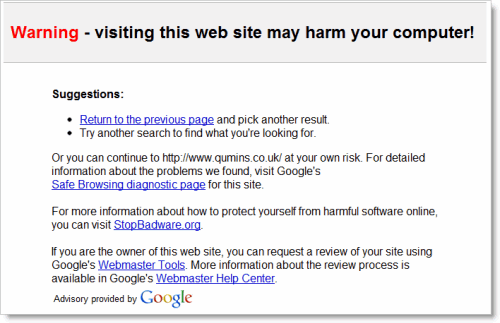
If you click the title of the result, you'll be shown the following warning rather than being taken immediately to the webpage in question:

Malware warning page

You can choose to continue to the site at your own risk. However, please be aware that malicious software is often installed without your knowledge or permission when you visit these sites, and can include programs that delete data on your computer, steal personal information such as passwords and credit card numbers, or alter your search results. For more information on these types of sites, please visit StopBadware.org

If one of these sites downloads malicious software onto your computer, please read our additional information about reporting these sites and removing the software from your system.

If you're the administrator of a site we've identified with this warning message, please visit the instructions found in our Webmaster Help Center to resolve the problem. Note that in some cases, third parties can add malicious code to legitimate sites, which would cause us to show the warning message.

Monday, October 29, 2007

Chhodo Na Mujhe Yun Beqaraar Saa

You must be thinking why this song is here .. right? ..i am sure you..............

Chhodo Na Mujhe Yun Beqaraar Saa
Kar Bhi Do Izhaar Tum Apne Pyaar Kaa
Tumhaare Dil Ki Hai Ye Manzil Mera Deewana Dil
Bolo Tum Bolo
Ho O Ho O
Kar Doge Inkaar To Jee Na Paayenge
Jo Kar Doge Iqraar To Mar Hi Jaayenge
Tumhaare Dil Ki Hai Ye Manzil Mera Deewana Dil
Bolo Tum Bolo
Ho O Ho O Yeah

Itne Paraaye Jo Ho Tum Pahle Kabhi Bhi Na The
Mere Jahaan Mein Ghamon Ki Ho
Tum To Vajah Hi Nahin The
Dil Se Mere Tum Khud Ko Nikaalo
Yaa Phir Mujhe Hi Apnaa Banaa Lo
Bolo Tum Bolo
Ho O Ho O

Khoyee Khoyee Zindagi Ki
Raahon Mein Ab Aa Bhi Jaao
Jo Tum Nahin Aanaa Chaaho Mujhko Hi Paas Bulaao
Kab Tak Jiyenge Aise Bataao
Mujhko Nahin Tum Aazmaao
Bolo Tum Bolo
O O Ho O
Chhodo Na Mujhe Yun Beqaraar Saa
Chhodo Na Mujhe Hun
Kar Bhi Do Izhaar Tum Apne Pyaar Kaa
Tumhaare Dil Ki Hai Ye Manzil Mera Deewana Dil
Bolo Tum Bolo
Ho O Ho O Ho O Ho O

Tuesday, July 31, 2007

Saturday, April 21, 2007

By the way today is my Birthday, Wish me people.... ;-)

Well, today i grow older by one more year :-( Still I am very happy, the days I enjoyed in last 3 years i never enjoyed in whole of my life i guess, these years are my happiest moments of my life (cos next year i might get married)

All credits goes to my Mom and God (Obvious)

Cheers to all of my friends and my family

By the way I was very very busy these days so couldn’t update anything on my blog, so i guess i can be able to update in future.

Pradeep SV

Sunday, October 15, 2006

Tuesday, April 11, 2006

New search engine 'revolutionary'

A 26-year-old PhD student from the University of New South Wales has patented a new way of exploring the web that could revolutionise existing search engines.

Developed by Ori Allon, the Orion© search engine is designed to complement searches conducted on services such as Google, Yahoo or MSN Search.

Search engines find pages on which keywords occur. Sometimes these pages are important to the topic. Other times they are not.

Orion© finds pages where the content is about a topic strongly related to the key word. It then returns a section of the page, and lists other topics related to the key word so the user can pick the most relevant.

"The results to the query are displayed immediately in the form of expanded text extracts, giving you the relevant information without having to go to the website - although you still have that option if you wish," said Israeli-born Allon, who completed a Bachelor and Masters degree at Monash University in Melbourne before moving to UNSW for his PhD.

"By displaying results to other associated key words directly related to your search topic, you gain additional pertinent information that you might not have originally conceived, thus offering an expert search without having an expert's knowledge.

"Take a search such as the American Revolution as an example of how the system works. Orion© would bring up results with extracts containing this phrase. But it would also give results for American History, George Washington, American Revolutionary War, Declaration of Independence, Boston Tea Party and more. You obtain much more valuable information from every search.

"The idea of finding information without having to click through to websites came from Allon's supervisor, Eric Martin, back in March this year. "I provided the spark. But it is Ori who has developed this through his amazing creativity and sheer hard work over these past months," said Mr Martin.

Andrew Stead of New South Innovations, the technology transfer company within UNSW, says he is confident that Orion© will fill a gap in the market noted by Microsoft founder Bill Gates.

"Bill Gates was recently quoted in Forbes magazine as saying that we need to take the search way beyond how people think of it today. We believe that Orion© will do that."

Google exploring new search technique

Google has launched a new search project with an Australian university student, designed to let people view more information per search result without having to click open every link.

Ori Allon, a doctoral student at the University of New South Wales, was recently hired by Google to continue developing his Orion search engine, according to a university representative.

"Ori is an employee of Google, but this is still a university project," the representative noted, adding that Allon works out of the company's California office.

Orion aims to take a keyword and find pages most closely related to the topic and then deliver a portion of that particular page.

"The results to the query are displayed immediately in the form of expanded text extracts, giving you the relevant information without having to go to the Web site--although you still have that option if you wish," Allon said in a previous statement about his technology.

He cited an example of the keyword phrase "American Revolution." The search would not only provide extracts with the phrase, but also additional information on topics such as American history, George Washington and the Declaration of Independence.

Monday, March 13, 2006

The Net's New Age

Technology that aims to revolutionize how surfers use the Web is fueling a new wave of Internet investment and challenging established media

In a small deal that signals big changes on the Internet, Google announced Mar. 9 that it has acquired a Silicon Valley sensation called Writely. The online word processor is still in the testing stage, but it's attracting attention as a free alternative to relatively expensive desktop applications like Microsoft (MSFT) Word.

But the transaction stands out for bigger reasons. Writely is one of dozens of companies that are infusing once-static Web pages with the power, speed, and features of sophisticated desktop applications. And by combining these online applications with the new wireless and broadband communications ability of the Web, they are redefining the Internet itself.

With an application like Writely, people can do much more than store documents online. They can also collaborate, often in new and unique ways. Groups can work together on a document, making changes that appear in real time and doing so without the need to reload the Web page.
MAIL MADE EASY. Such innovations are fueling a new Internet boom that rivals the growth of the mid-to-late '90s. Referred to collectively as Web 2.0., the new technologies are drawing a fresh influx of dollars to the Net.

Investors are backing the development of new companies like Writely and social bookmarking site del.icio.us, which was snapped up by Yahoo! (YHOO), giving rise to a new generation of entrepreneurs, such as 31-year-old del.icio.us founder Joshua Schachter (see our BW Online slide show). Established Web giants like Google (GOOG) are tapping Web 2.0 to spawn new avenues of growth, create jobs, and usher in an age where the Internet emerges as a credible rival to established media and communications companies. The Web 2.0 designation covers a broad range of tools and applications. There are new tools like del.icio.us, which allows users to store their bookmarks at a Web site, "tag" them with category names, and share their lists of favorite links with friends or the public. Del.icio.us even keeps track of most popular Web pages, much as Billboard ranks top tunes. Other up-and-coming Web 2.0 companies include edgeio.com, a new way to distribute classified ads.

Another example is Google's Gmail service or Yahoo's new e-mail system Y Mail, which is in the testing stage. Users can now move e-mails from one folder to another by dragging and dropping them across the screen, just as if they were using a desktop application like Microsoft Outlook. Older forms of Webmail forced users to wait for the page to reload every time they moved e-mails, added an attachment, or opened a new message. These programs operate just like Outlook, except they're free.

A FEW SIMPLE CLICKS. Not to be outdone, Microsoft has its own raft of Web. 2.0 applications, Windows Live. The software giant has just outlined some ambitious targets for the project, including an aim to host 20 million users of its new e-mail service by June (see BW Online, 3/10/06, "Memo Outlines Microsoft's Plans").

A lot of the innovations are powered by a new kind of Internet technology, much of which was developed by Microsoft itself. Many, but not all, Web 2.0 companies use a software platform known as Ajax. Until now, you had to reload a Web page every time you wanted to save a change. If you want to add a news feed to your homepage at a Web 2.0 site like netvibes, all you need to do is make a few clicks.

There's no need to save the page and wait for it to reload, as you would if using older homepage platforms like My Yahoo. That's because Ajax, used to create netvibes, can save new information on your page without having to re-save the entire page with all the older data that didn't change.

MASS APPEAL? Web 2.0 and its antecedents have been a topic of conversation among entrepreneurs, bloggers, engineers, and other industry insiders for years. But now the new Web is working its way into the mainstream. Led by giants Yahoo and Google, the changes will be apparent over the next few months.

"Today, these are real niche applications," says Brad Garlinghouse, vice-president of communications products at Yahoo. "The exciting thing is that Yahoo is taking Web 2.0 to the masses." He said the new version of Y Mail will be the world's most widely used Web 2.0 application.

The implications reach far beyond the Net. The new Web is changing the business model for media and communications companies. Traditional players in these markets have built their businesses on a foundation of brand and content, forming a customer base and marketplace. In the Web 2.0 era, they'll aim to cultivate a community of users on the Web, according to Troy Young, executive vice-president and chief "experience architect" at Organic, an online advertising and consulting firm.

YOUR NEWS, YOUR WAY. The new business model begins with a platform and set of user tools based on Web 2.0 technology. It's used to attract a community of users, which in turn create a marketplace on the Web. "The content and brand emerges at the end of the cycle and it's created by the users," Young says.

The biggest news site, measured in terms of users and page views, is Yahoo. True to Web 2.0 form, Yahoo started with a set of Web communications tools and added news feeds. While traditional news organizations may turn up their noses at such commodity content, it's wildly popular with tens of millions of users who simply want to know what's going on in the world on a constant basis.

Even Yahoo's customizable news features are still relatively primitive by Web 2.0 standards. With the exception of the new e-mail program, it's not making much use of true Web 2.0 technology. By contrast, Newsvine.com allows users to create their own home pages and columns and comment on every story. Top stories are selected according to user patterns, not by editors. Users even get to keep 90% of the ad revenue that their home pages generate.

GATEKEEPERS NO MORE. The changes are upending long-established hierarchies in the news business. The core news operations of The New York Times (NYT) and The Wall Street Journal have relatively small audiences on the Web, but they're adapting quickly. And where they're not building, they're prepared to buy. Witness the New York Times' recent purchase of About.com and the acquisition of Marketwatch by Dow Jones, parent of the Wall Street Journal.

Expect to see the barriers between so-called Old Media and newer forms continue to crumble. "We want to work with traditional news organizations, syndicating their content," says Newsvine CEO and co-founder Mike Davidson, a veteran of Disney's (DIS) ESPN unit. "It doesn't have to be us-against-them."

But if incumbents in news, media, and other markets are to flourish, they will have to make changes. Their roles as gatekeepers and repositories of centralized content are fading. "Power is shifting toward the individual, operating at the edge of the network and away from the giant companies at the center of the network," says Michael Arrington, chairman of edgeio.com and the founder of techcrunch.com, a popular blog that tracks Web 2.0 companies. Adds Arrington: "It's a paradigm shift for everyone on the Internet."

"THERE'S SO MUCH CASH." Just as Newsvine is challenging news sites such as cnn.com, edgeio is targeting the established online marketplaces. It searches blogs for entries that have the keyword "listing." Then it organizes them at the edgeio Web site by geography and category. Arrington says it's cheaper than eBay (EBAY). And it eliminates some of the anonymity of Craiglist, which may be a desirable feature for many kinds of businesses.

Another sign of the Net's new times: demand for Web 2.0 companies is on the rise. Schachter and the other founders of del.icio.us didn't need more than an angel round of investors, allowing them to keep the lion's share of the proceeds of the Yahoo deal. Although Yahoo wouldn't comment, one person familiar with the matter says the outfit paid $27 million. "There's so much cash and opportunity, people don't often need venture capital funding," Arrington said.
Once again, the pace of Internet innovation is on the rise. Markets are being changed, and fortunes are being lost. And in that sense, Web 2.0 is very much like Web 1.0.

Wednesday, March 08, 2006

Microsoft's New Search Engine Challenges Google


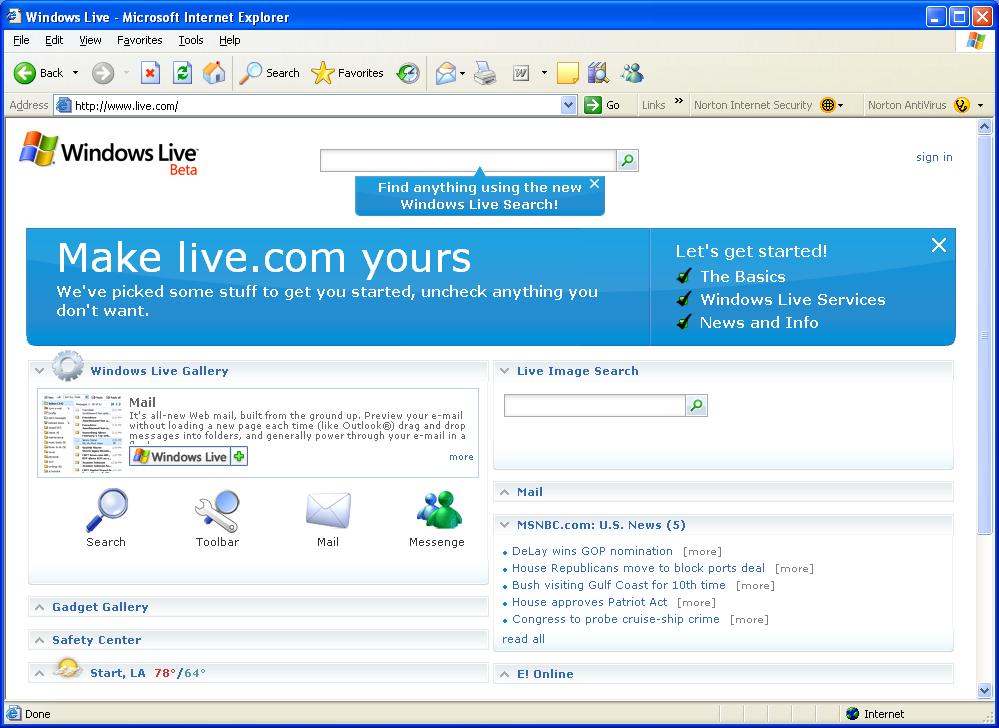
Microsoft has launched a new search engine that it says is better and faster than previous versions and will give Google a run for its money, reports PC Mag. The beta version of the engine is set to debut at http://www.live.com/, as is a Windows Live Toolbar beta. "To say we'll get to overall number one in a few months is a bit bold," Microsoft Microsoft Search Senior Product Manager Justin Osmer is quoted as saying. "But, maybe we'll be number one in some market metrics."

Microsoft could soon lead in local search and relevancy, Osmer said. Morepver, Microsoft will be using its own picture and video search technology rather than a third party's and will improve in those areas.

The new engine also will also have greater scope, including search, news search, RSS feeds, email search, local search and searching of MSN Shopping and MSN Spaces.

Live.com is intended to replace MSN.com.

Google: Revs Will Reach $100B; Eyeing TV, Radio, Print, Direct Advertising


After Google's CFO, George Reyes, made comments that prompted a sell-off of Google stock earlier in the week (all he said was that sales growth rates would slow, given Google's size), the online behemoth was under pressure to reassure investors - and did so splendidly - writes the Times Online. Google's top leadership gave a super-upbeat presentation to analysts, saying the company would expand into every area of media and set as its objective revenues of $100 billion a year. Those remarks should worry many in the traditional media business.
Google said it aims to become a presence in every part of the $800 billion global advertising market - from television and radio to print and direct marketing. "We see ourselves in every one of those segments.... It will be possible in the next few years," Eric Schmidt, Google's CEO said.

Google execs said the company would increase sales by improving search engine and ad quality by investing in infrastructure and new technologies.

The stock gained after the presentation, going past $386 a share, up from below $340 earlier this week - but still 20 per cent off the $475 high earlier this year.

Google derives more than 97 percent of its revenue from search-related advertising. It has 40 percent of the U.S. market for web searches and 60-80 percent of most European markets, according to comScore.

Friday, March 03, 2006

Google Tries to Reassure Wall Street

Google shares may have fallen toward earth in recent weeks, but its executives still think that the sky's the limit for the company's growth opportunities.

With the share price down 20 percent from its high this year and investors increasingly skittish, Google offered a detailed and sober appraisal yesterday of its finances and strategy, a presentation meant to reassure investors that as a rapidly growing company, it still saw boundless opportunities to expand its Internet services and advertising network.

The meeting, in Mountain View, Calif., Google's headquarters, was a sharp contrast to 2005's gathering, which investors found frivolous and lacking in substance.

Last year, instead of hearing from Google's chief financial officer, analysts were treated to a presentation by the company's chief cook, Charlie Ayers, on the lunch menu for the meeting.
This year, the chief financial officer, George Reyes, was the master of ceremonies. Dressed in black, he gave a long recitation of Google's past results, as finance chiefs customarily do at such events.

Jordan Rohan, an analyst with RBC Capital Markets, said that Google's presentations were more polished and professional this year and that executives addressed the questions most in the minds of investors.

"The company appears to have matured significantly since its first analyst day a year ago," Mr. Rohan said.

"Investors have been successful," Mr. Rohan said, "in communicating with the management they can't be this funky renegade company."

Keeping to Google's stated policy, neither Mr. Reyes nor any other executive offered specific financial predictions or other quantitative insight into the company.

But Eric E. Schmidt, the chief executive, quickly sought to counteract the impression that Mr. Reyes had given investors on Tuesday implying that some of Google's opportunity revenue growth might be slowing.

The company's shares rose as Mr. Schmidt began to speak, and they closed at $376.45, up 3.2 percent.

Mr. Schmidt defined Google's opportunity as increasing its share of the worldwide market for advertising of all types, not just online, which he estimated to be $600 billion to $800 billion.
The company's advertisers "don't want to be just on text ads and just on Google," he said. "They want to be everywhere on all sorts of media."

Google has started selling advertisements in print publications and has bought a company that sells radio ads. And it said that it hoped to find a way to sell television ads as well.
Mr. Schmidt teased the audience with what might be an audacious goal: "building the systems and infrastructure of a global $100 billion company."

Then he added, "I'll give you the choice of whether that is $100 billion in market cap or revenue."

Since Google's market capitalization is already $111 billion, Mark Stahlman, an analyst with Caris & Company, said he took that to mean $100 billion in revenue. That is perhaps a bit of a stretch for a company that had revenue of $6 billion last year. (Mr. Stahlman, who is especially bullish on Google's stock, predicts that it could reach that level in five years.)

While Google executives seemed to take the analysts more seriously this year, they remained dismissive of competition from Microsoft and others.

Marissa Meyer, vice president for product management, disputed claims by Yahoo and Microsoft that the results from their search engines were as relevant as Google's.

Ms. Meyer listed several new technologies, including one that corrects for what seem to be mistakes in search queries. If someone searches for "CBS Alias," the system will now guess that they might be looking for information about the television program that is actually broadcast by ABC, and it will show results for the query "ABC Alias" as well as what the user asked for.

"We think the gap with the competition is as large as it has been," Ms. Meyer said.

Alan Eustace, the vice president for research and systems engineering, asserted that Google's worldwide computer network was much more powerful and efficient than any other Internet company's.

"We don't think our competitors can deploy systems cheaper, faster or at scale," he said. "That will give us a two-, three-, five-year lead."

Mr. Reyes tried to assure investors that Google was more than a bunch of unsupervised engineers playing volleyball and riding around on scooters. He detailed a strategic planning process that the company follows and listed financial measurements it monitors, like the average revenue it receives for each search. But he warned the analysts not to ask for specifics on any of those figures.

"We do follow and closely monitor these metrics," he said, "but we are not prepared to share them with you at this point in time."

Mr. Reyes took pains to indicate that growth was not slowing as much as some investors feared, underlining rapid worldwide expansion.

"The question I get asked a lot is, 'Is international expansion slowing?' " he said. "The answer is no."

Mr. Schmidt also talked about Google's payment system, which it recently introduced.
He reiterated that it was not meant to allow one person to transfer money to another, in competition with PayPal, part of eBay, which has been Google's largest single advertiser. Rather, he hopes that it will allow advertisers on Google to let users click and buy products right from the ads.

Mr. Stahlman, the analyst, said that in the informal conversations, Google executives were unusually forthcoming. In particular, he noted that the second half of the presentation was delayed 30 minutes because a crowd of investors surrounded Mr. Schmidt. "Eric was answering everyone's questions," he said.

When asked about the Google's biggest single opportunity, Mr. Stahlman said Mr. Schmidt cited advertising on cellphones.

"They had much more meat than they ever offered before," he said of the meeting.